 Written by
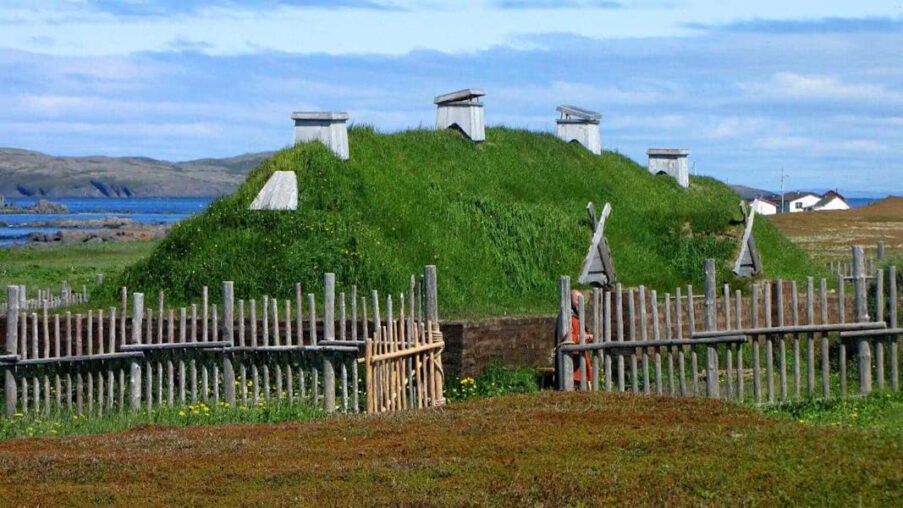
 Vikings in North America us not news. Their voyage was documented in two medieval Icelandic texts: the Saga of the Greenlanders (Grœnlendinga saga) and the Saga of Erik the Red. In the 1960s, archeological proof was found at the L’Anse aux Meadowd settlement in Newfoundland Canada. The above photo is a recreation of a longhouse from that settlement.
Today, the United States is phasing out Christopher Columbus Day om favor of Indigenous Peoples Day and has added Leif Erikson Day in honor of the first Europeans to visit North America. The Christopher Columbus myth has been busted for the better part of a century.
What is news is the year to be no later than 1021 CE Previously, a precise date could not be set by radiocarbon dating. Although radiocarbon dating works on trees and wood planks, it could only place the age at about the turn of the century.
Newer science has determined that trees record Miyake events in there rings with specific signatures. Miyake events are sharp spikes in cosmic radiation. From ice core samples, each Miyake event is known. There was in in 7176 BCE, 5259 BCE, 664–663 BCE, 774 CE, and 993 CE). Once a tree ring has been identified with the signature of a Miyake event, the rings that formed after that event can be counted to determine the year the tree stopped growing.
With that new science, archeologists could date the lumber preserved from the L’Anse aux Meadowd settlement to determine the felling year. Although these results do not indicate the exact year Vikings arrived in North America, by 1021 CE Vikings were actively producing lumber and building structures.
- ZME Science: Vikings really did reach North America a thousand years ago — and now we know exactly when